|
|
SCSRPC
Mission Statement ►

SCSRPC Coordinator
Thomas H. Terrill
Fort Valley State Univ, GA
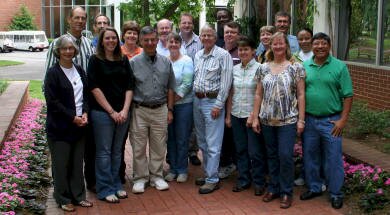
SCSRPC Members
Joan M. Burke
USDA, ARS, AR
Paul Casey
Heifer Internationsl, AR
Linda Coffey
NCAT, ATTRA, AR
Nelson Escobar
Univ of Maryland Eastern Shore, MD
Will R. Getz
Fort Valley State Univ, GA
Margo Hale
NCAT, ATTRA, AR
Steve Hart
Langston Univ, OK
Sue Howell
Univ of Georgia, GA
Dahlia Jackson-O'Brien
Delaware State Univ, DE
Ray M. Kaplan
Univ of Georgia, GA
Jean-Marie Luginbuhl
North Carolina State Univ, NC
James E. Miller
Louisiana State Univ, LA
Byeng R. Min
Tuskegee Univ, AL
Seyedmehdi Mobini
Fort Valley State Univ, GA
Jorge Mosjidis
Auburn Univ, AL
Jim Muir
Texas A&M Univ, TX
Susan Schoenian
Univ of Maryland, MD
Bob Storey
Univ of Georgia, GA
Thomas H. Terrill
Fort Valley State Univ, GA
Elide Valencia
Univ of Puerto Rico, PR
Adriano Vatta
Univ of Georgia, GA
Niki Whitley
North Carolina A&T State Univ, NC
Anne Zajac
Virginia Tech, VA
SCSRPC Affiliate Members
Richard Erhardt
Michigan State Univ, MI
Bill Shulaw
Ohio State Univ, OH
Sims Bros
Union Springs, AL
SCSRPC International
Collaborators
Gareth F. Bath
South Africa
Jan A. Van Wyk
South Africa
Felipe Torres-Acosta
Universidad Autonoma de Yucatan Merida, Mexico
Herve Hoste
INRA Toulouse, France
Producer Information ►
Projects ►
Events ►
Workshops
FAMACHA©
Smart Drenching
Presentations ►
FAMACHA© ►
How To Order
Information Guide
Sericea Lespedeza ►
Publications ►
Links ►
Contact Us ►
SCSRPC Member
Pictures ►
Website questions or comments? Contact .

|
|
|
|

SARE

Fort Valley State University
|

Smart Drenching
information here ►
|
FAMACHA©
information here ►
|
|

The mission of the SCSRPC is to develop and validate novel methods for sustainable control of gastrointestinal nematodes in small ruminants and to educate stakeholders in the small ruminant industry on methods and recommendations for gastrointestinal nematode control. (Mission Statement ►)
Donate to support research and outreach activities of the ACSRPC (New name for SCSRPC) to promote sustainable parasite control in livestock. ►
Announcements
|
New name for SCSRPC
Due to expansion of our membership, we have decided to change our name from the Southern Consortium for Small Ruminant Parasite Control (SCSRPC) to the American Consortium for Small Ruminant Parasite Control (ASCRPC). Only our name will be changing. Our mission will remain the same. Changes to our name on our web site will be coming soon.

With Regard to the Moxidectin Injectable vs. Oral Issue in Goats
Moxidectin (Cydectin) is not approved for use in goats; therefore, there are no established withdrawal times (WDT) for meat and milk. FARAD, a national, USDA-sponsored, cooperative project, with a primary mission to prevent or mitigate illegal residues of drugs, pesticides and other chemicals in foods of animal origin, makes recommendations for extra-label drug use in food animals and these recommendations serve as the defacto WDT guidelines that should be followed. Recently, FARAD came out with a 120-130 day recommended WDT for meat following use of injectable moxidectin. Without data specifically demonstrating that the injectable provides superior efficacy, we decided it was best to withdraw the recommendation for using injectable moxidectin. Although the blood level data indicates injectable may be the preferred route, whether or not this translates to better efficacy depends on the amount of drug actually getting into the worm. It makes sense that it would since Haemonchus feeds on blood, but it is possible that the oral route might still be better if high levels of the drug are getting into the worm via direct contact in the stomach. A study was planned this summer at UGA to compare the efficacy of the oral and injectable routes, but not a single farm in Georgia could be found with moxidectin susceptible worms (6/6 were highly resistant). Only large (>100 goats) farms were tested because lots of goats were needed to do the study, so the situation may not be quite as bad on smaller farms. But overall, >50% of all farms tested by DrenchRite at UGA from 2007-2009 had moxidectin resistance. So, moxidectin is on its last legs in goats in the southeastern US either way, and without clinical proof, we feel it is better to stick with the oral route (if the worms are susceptible) since this route has a reasonable withdrawal time (23 days). Furthermore, it is important to only use products that are designed for oral administration. Thus, only the sheep oral drench product should be used; the pour-on form for cattle (given orally) should not be used, and is not allowed under extra-label drug use law.
|
Southern SARE News
Sericea lespedeza has been evaluated in several SARE projects as a high-quality, low input forage that also suppresses gastro-intestinal parasites.
A New Look at Lespedeza
South African farmer holds second sericea seminar at FVSU
(full article) ►
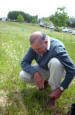
South African beef, dairy and wool sheep producer Hendrik Botha examines a new stand of sericea lespedeza on the Fort Valley State University research station.
Parasite Control for Goats: Series of Six Articles
by
The Southern Consortium for Small Ruminant Parasite Control
The SCSRPC authored this series of articles in Goat Rancher Magazine on worms in sheep and goats because of the abundance of disinformation on the subject. This series is one of the most comprehensive and accurate sources of information on sheep and goat worms in the Southeastern US. It covers various types of worms, management for preventing worms, FAMACHA, selection of dewormers, alternative dewormers and how to do your own fecal egg counts and dewormer research.
(see articles here) ►
NEW Smart Drenching and FAMACHA Integrated Training for Sustainable Control of Gastrointestinal Nematodes in Small Ruminants ►
Tools For Managing Internal Parasites in Small Ruminants
Sericea Lespedeza ►
Copper Wire Particles ►
|
|

Electron micrograph of an adult Haemonchus worm with the lancet structure
SCSRPC members may be available for workshops on FAMACHA© training and smart drenching recommendations. Please contact us with your request.
SCSRPC Member contacts ►
|
|
|
|
|
|
